For founders and business owners / NXG Studios
The 2027
Personal Brand
Playbook.
How to get known for what you actually know. One recording a month, 30 days of content, and a clearer path from viewer to client.
No dancing. No trends. No 50-person team.
What is the 2027 Personal Brand Playbook?
The 2027 Personal Brand Playbook is NXG Studios’ practical guide for founders, doctors, consultants and business owners who want to share their expertise through podcast and video content. It connects a clear audience promise with four content pillars, 36 topic prompts, a batch-recording plan and a four-week publishing calendar. Start by answering real client questions, use examples you can substantiate and review the quality of conversations—not just follower counts. The guide is written by NXG Studios in Bengaluru and adapted from the original 16-page PDF. Its output counts are illustrative planning targets, not included services or guaranteed results.
00 / Why now
Generic content is everywhere.
Your experience isn’t.
What makes your content worth watching is not another polished caption. It is your face, your judgement, your client stories and the things you learned the hard way.
This is a planning framework for 2027, written in November 2026—not a promise of reach, search rankings or clients. Start with what you can prove, then build a repeatable habit.
Step 01
The five rules.
Specific beats impressive.
“Business coach” is a category. “I help Bangalore restaurant owners fix their food costs” is a promise people remember.
Your face is the brand.
Show up in your own voice, with opinions and stories drawn from the work you actually do.
Make one thing. Cut it into many.
Record a useful long-form conversation. Give it a second life as clips, articles and takeaways.
Consistency beats virality.
Build a publishing rhythm you can sustain. Do not mistake a quiet first month for failure.
Every piece points somewhere.
Give people one next step: follow, watch the full episode, subscribe or start a conversation.
Step 02
Position yourself in one sentence.
I help who get result without pain, because proof.
I help [who] get [result] without [pain], because [proof].
Could a competitor say exactly the same thing? Make it more specific. Can you back up your “because”? If not, fix the proof first.
Step 03
Your four content pillars.
Teach to get found. Prove to get trusted. Opine to get remembered. Reveal to get liked.
40%
Teach
Get found.
Answer the questions clients ask before they hire you.
20%
Prove
Get trusted.
Share a real project, its process and its result—with permission.
20%
Opine
Get remembered.
Explain an industry myth or a view you can defend.
20%
Reveal
Get liked.
Show the decisions, mistakes and people behind your work.
Step 04
The topic bank.
36 starting points. Your best topics are the questions clients already ask you.
Client questions
- 01The 3 questions every client asks before hiring a [your role]
- 02How much does [your service] really cost, and why
- 03How long does [result] actually take
- 04DIY or hire a pro: an honest answer
- 05What I wish clients knew before our first meeting
- 06How to tell a good [your role] from a bad one
Opinions & trends
- 01Where [industry] will be in 2030
- 02How AI is changing [your work], honestly
- 03The trend I think is overhyped
- 04What [city] gets wrong about [topic]
- 05One rule I’d change in my industry
- 06Reacting to [recent news] in my field
Mistakes & myths
- 01The most expensive mistake I see in [industry]
- 025 myths about [topic] that cost people money
- 03What everyone gets wrong about [trend]
- 04Red flags when choosing a [service provider]
- 05“Advice” from the internet that’s actually dangerous
- 06The mistake I made so you don’t have to
Behind the scenes
- 01How I actually run my week
- 02The tools and systems behind my business
- 03Why I started, the real version
- 04How I price my work
- 05What a hard month looks like
- 06The team behind the work
Stories & proof
- 01A client case: the problem, the fix, the result
- 02The project that almost went wrong
- 03My first client, and what I’d do differently
- 04Before and after: a full walkthrough
- 05The weirdest request I’ve ever had
- 06The deal I walked away from, and why
Guest episodes
- 01A client on why they chose you
- 02A peer from a related industry
- 03A mentor on lessons from 20 years in
- 04A supplier or partner on how your industry works
- 05A competitor, friendly debate
- 06A rising local founder on their story
Step 05
One session. A month of content.
The input
1
Half-day studio session.
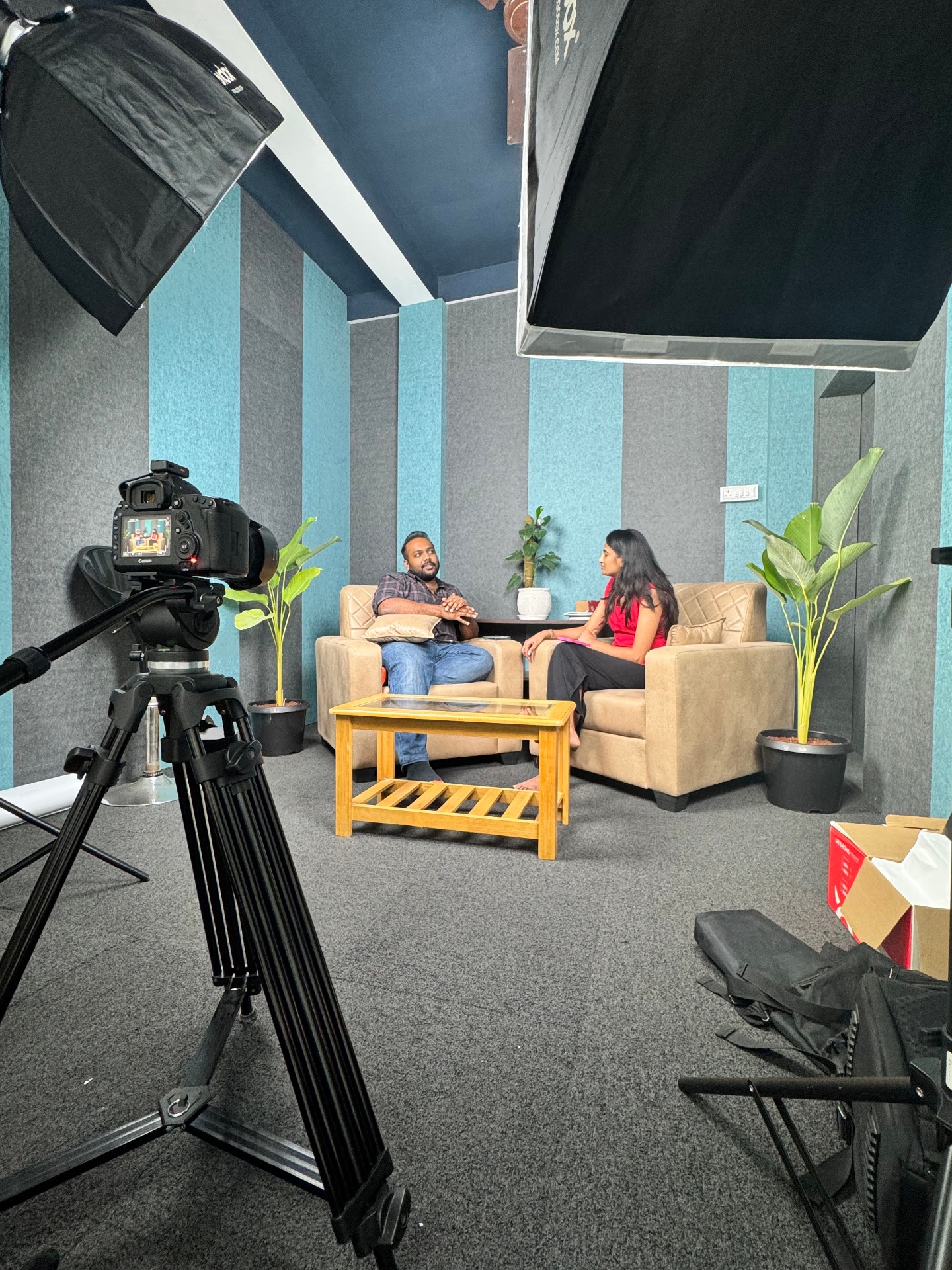
Three to four episodes, batched. Multiple cameras, proper lighting and clean audio.
Full episodes
4YouTube and Spotify. One a week.
Short clips
16+Four to five useful moments per episode.
Carousels
4Frameworks and key takeaways.
LinkedIn posts
4One sharp idea from each conversation.
Blog posts
4Transcripts edited into useful articles.
WhatsApp drops
4A weekly episode for your opted-in audience.
Quote cards
8+The strongest lines, in context.
Stories
20+Behind the scenes from the shoot.
Illustrative output plan from the PDF, based on four episodes—not a package inclusion or a guaranteed deliverable. Actual output depends on recording length, usable material and the editing scope you agree.
Step 06
Pick your platforms.
One home for long-form. Two places to distribute. You do not need to be everywhere.
Selling to people
YouTube + Instagram + WhatsApp
Reels for discovery. YouTube for depth. Opted-in WhatsApp conversations for follow-up. A practical starting mix for clinics, realtors and coaches.
Selling to businesses
YouTube + LinkedIn + WhatsApp
LinkedIn for professional credibility. YouTube to show your thinking. WhatsApp or email to continue a conversation with consent.
Step 07
Record like a pro.
Solo · 12–20 minutes
The expert breakdown
- The problem in one line
- Why it matters
- Your three-step answer
- A real example
- The mistake to avoid
- One next step
Two people · 30–45 minutes
The guest conversation
- The best 20 seconds
- The guest’s story
- The big lesson
- One useful disagreement
- Rapid-fire questions
- Where to find the guest
You + a client · 20–30 minutes
The client story
- Where they were before
- What they tried
- Why they chose you
- What you actually did
- The real result
- Advice for their peers
Before you walk in
Bring bullet points, not a script. Prepare one story and one real number per episode. Brief your guest, bring two outfits, silence your phone and know your next-step invitation. Get written permission from every guest or client you feature.
Step 08
Hooks and titles.
Lead with the problem, not your introduction. These are templates, not client claims: fill them with specifics you can substantiate.
01 / The costly mistake
“This one mistake costs [audience] [real cost].”
02 / The insider
“After [years] as a [role], here’s what I’d never do.”
03 / The contrarian
“Stop [common advice]. Here’s why.”
04 / The number
“We got [verified result]. Here’s the breakdown.”
05 / The question
“Is it worth [decision] in [city/year]?”
06 / The before & after
“This [project] started here. [Time] later…”
07 / The confession
“I lost [something important]. My fault.”
08 / The red flag
“If your [provider] says this, ask more questions.”
09 / The shortcut
“The [time] habit that changed [process].”
10 / The comparison
“[Option A] vs [Option B]: what I’d choose.”
11 / The prediction
“Here’s what I think changes next in [industry].”
12 / The direct callout
“If you run a [business] and face [problem], watch this.”
Name the problem. Add a meaningful specific. Use the language your audience actually searches for.
Step 09
The 30-day calendar.
Four episodes, four weeks. Sundays are off from posting. Use the remaining days for review and your next batch.
Week 1
- Monday
- Episode 1 + blog post
- Tuesday
- Best hook from episode 1
- Wednesday
- Episode 1 takeaways
- Thursday
- Story moment from episode 1
- Friday
- One idea on LinkedIn
- Saturday
- Contrarian take
- Sunday
- No post · reply to comments
Week 2
- Monday
- Episode 2 + WhatsApp drop
- Tuesday
- Guest’s best line
- Wednesday
- Behind the scenes + poll
- Thursday
- Myth-busting clip
- Friday
- Episode 2 framework
- Saturday
- Quick tip
- Sunday
- No post · reply to comments
Week 3
- Monday
- Episode 3 + blog post
- Tuesday
- A real number or result
- Wednesday
- Mistakes to avoid
- Thursday
- Personal story
- Friday
- Client lesson on LinkedIn
- Saturday
- Answer a comment on video
- Sunday
- No post · reply to comments
Week 4
- Monday
- Episode 4 + WhatsApp drop
- Tuesday
- Strongest hook of the month
- Wednesday
- Q&A: answer five questions
- Thursday
- Before & after or proof
- Friday
- Month recap: five ideas
- Saturday
- Offer or next step
- Sunday
- No post · monthly review
The daily 15 minutes: reply to comments and messages. Early on, real conversations matter more than posting another clip.
Step 10
Turn viewers into conversations.
Do not ask a stranger to buy. Invite the next small step.
Viewer
Follow for more on this topic.
Follower
Watch the full episode.
Subscriber
Get a useful guide—with consent.
Conversation
Tell me your situation.
Client
Book a call if we’re a fit.
Days 1–30
Watch your consistency
Did you publish on schedule?
Days 31–90
Watch the quality of attention
Watch time, saves and comments from the right people.
Day 90+
Watch real enquiries
Messages, calls and clients who mention your content.
Putting it together
Your first 90 days.
Weeks 1–2
Set up
Write your positioning. Pick two or three platforms. Fix your profiles. Choose eight topics and book your batch day.
Weeks 3–4
First batch
Record four episodes, commission clips, load your calendar and publish episode one. Reply to the people who engage.
Month 2
Find the signal
Record again. Look at what held attention. Try a guest conversation and start an opted-in WhatsApp list.
Month 3
Convert
Add a useful checklist, record a client story with permission and track where enquiries come from. Plan the next quarter.
These are planning milestones, not guaranteed business results.
Personal branding: practical answers.
How can a founder start building a personal brand?
Choose a specific audience and a problem you can help solve. Write a one-sentence promise backed by real experience, then record answers to the questions clients already ask. Publish consistently and invite one useful next step.
How can one recording session support a month of content?
Batch three to four episodes in one session, then repurpose useful moments into clips, takeaways and articles. The example calendar spreads four episodes across four weeks. Output depends on the recording and agreed editing scope; it is not a guaranteed package.
Which platforms should business owners choose?
Start with one home for long-form content and two distribution channels. The playbook suggests YouTube, Instagram and opted-in WhatsApp for consumer-facing businesses, or YouTube, LinkedIn and consent-based follow-up for B2B businesses. Adjust the mix to where your audience spends time.
What should you measure in the first 90 days?
In the first month, measure whether you publish on schedule. Through day 90, review watch time, saves and relevant conversations. After that, track enquiries and booked calls by source. The 90-day plan is a working rhythm, not a promise of clients.
About this guide
Written by NXG Studios, a podcast and video production studio in Bengaluru. This web edition focuses on the PDF’s practical framework; platform statistics have not been independently verified and are not used as promises here. The original PDF includes its source list and illustrative examples.
Planning a recording in Bengaluru? See our podcast studio and current studio rental pricing.
Podcast Visuals / NXG Studios · Bengaluru
You bring the expertise.
We handle the recording.
Plan your set, cameras, lighting, sound and editing with NXG Studios. Agree the scope for your batch day before you book.
Also from NXG Studios
Raj Shamani: one mic, a borrowed classroom.